

Strength Guides
Pablo mg per Pouch Explained: How to Read Every Can
Oct
Pablo mg per pouch explained: how to read every can
Pablo mg per pouch figures confuse plenty of shoppers, because listings point to two different numbers.
One number is nicotine per gram of pouch content. The other is the nicotine inside a single pouch.
Mixing them up leads to big mistakes. For example, “Pablo 50mg” does not mean 50 mg in each pouch.
This guide walks through the formula first. Then it works the math out for every line we stock.
Key takeaways
- Nicotine per pouch equals mg/g multiplied by the pouch weight in grams.
- Exclusive lists 50 mg/g, so each 0.6 g pouch holds 30 mg.
- Original, XXL, Dry and Mini all share 30 mg/g, yet their pouches range from 15 to 24 mg.
- Silver Edition works out to 10.15 mg, which the can rounds to 10 mg.
- Always compare products by the per-pouch figure rather than the bigger headline number.
Two numbers, two different jobs
Import-line Pablo products are usually listed by strength in mg/g. That figure describes concentration, not dose.
Concentration tells you how much nicotine sits in each gram of pouch content. Think of it like a percentage.
Dose, by contrast, tells you how much nicotine one pouch holds.
That is the figure you actually place under your lip.
The two numbers only match when a pouch weighs exactly one gram. However, no Pablo pouch weighs that much.
As a result, the per-pouch figure always comes out lower than the mg/g figure for these lines.
Quick rule: when a Pablo number looks surprisingly high, it is probably mg/g rather than nicotine per pouch.
N.G.P Tobacco ApS in Aalborg, Denmark, makes Pablo. You can view the company’s manufacturer profile at Intertabac.
The formula behind every Pablo can
The math takes one line. Simply multiply the nicotine per gram by the weight of one pouch.
So the formula reads: mg per pouch = mg/g × pouch weight in grams. That is the whole calculation.
You can also check it from the other side.
First, multiply mg/g by the net weight to get nicotine per can.
Then divide that can total by the pouch count. You should land on the same per-pouch number.
For instance, an Original can holds 16 g at 30 mg/g.
That gives 480 mg across 20 pouches, or 24 mg each.
When both routes agree, the listing is consistent. When they clash, something on the page is wrong.
Pouch weight is the missing piece on many listings.
Fortunately, you can work it out from net weight and pouch count.
A 14 g can with 20 pouches, for example, means each pouch weighs 0.7 g.
Worked examples for every Pablo line
Here is the math for each line, using the maker’s published specs.
We start with the lightest and finish with the strongest.
Silver Edition: 14.5 mg/g × 0.7 g
Silver Edition lists 14.5 mg/g. Each pouch weighs 0.7 g, so the result is 10.15 mg per pouch.
Listings round that figure to 10 mg, which explains why you see both numbers online.
A Silver can holds 14 g net across 20 pouches. That works out to about 203 mg per can.
The maker labels Silver as extra strong. Still, it remains the lightest of the classic import lines.
Browse the flavors in our Silver Edition category, from Spearmint to Pear.
Gold Edition: 24.3 mg/g × 0.7 g
Gold Edition uses the same 0.7 g pouch as Silver. However, the concentration jumps to 24.3 mg/g.
Multiply them and you get 17.01 mg, which listings state as 17 mg per pouch.
Because the pouch size stays the same, the whole gap between Silver and Gold comes from concentration.
Gold carries an ultra strong label. Its 14 g can holds roughly 340 mg in total.
Original: 30 mg/g × 0.8 g
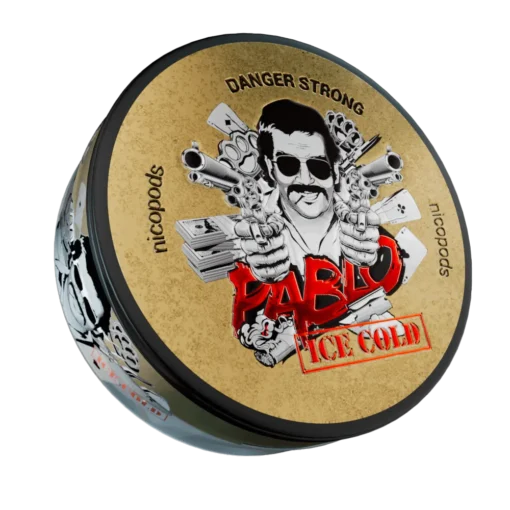
The Original line covers Ice Cold, Red and X Ice Cold. Each one lists 30 mg/g.
Its pouches weigh 0.8 g, the largest in the import range. Therefore each pouch carries 24 mg.
A 16 g can with 20 pouches holds 480 mg overall. The maker calls this tier super strong.
XXL: same pouch, bigger can
Ice Cold XXL also lists 30 mg/g with a 0.8 g pouch. So the per-pouch figure stays at 24 mg.
The change is the can itself.
XXL packs 30 pouches and 24 g net instead of 20 pouches and 16 g.
That raises the can total to 720 mg, while each single pouch matches a standard Original.
Bigger can, same pouch: XXL changes how long a can lasts, not the nicotine in each pouch.
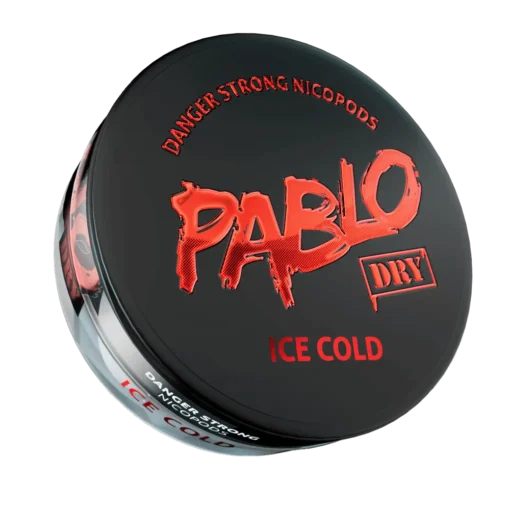
Dry: 30 mg/g × 0.6 g
Dry Ice Cold shares the 30 mg/g concentration. Yet its low-moisture pouch weighs only 0.6 g.
Multiply 30 by 0.6 and you get 18 mg per pouch. That sits six milligrams below Original.
A Dry can holds 12 g net and 20 pouches, which adds up to 360 mg per can.
Mini: 30 mg/g × 0.5 g
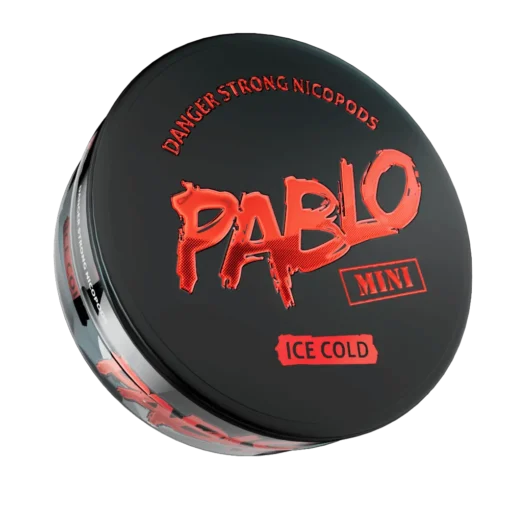
Mini comes in Ice Cold, Red and X Ice Cold, again at 30 mg/g. Its pouch weighs just 0.5 g.
So each Mini pouch carries 15 mg. Meanwhile, the can holds 30 pouches and 15 g net.
That gives 450 mg per can. Mini suits adults who want a smaller pouch with a familiar mint flavor.
Exclusive: 50 mg/g × 0.6 g
Exclusive lists the highest concentration in the brand, at 50 mg/g. Its slim pouch weighs 0.6 g.
The math gives 30 mg per pouch, which makes Exclusive the strongest line by a clear margin.
Each 12 g can holds 20 pouches and about 600 mg in total. The maker labels it extreme.
We cover this line in depth in how strong Pablo Exclusive really is.
Pablo mg per pouch compared across lines
The table below puts every import line side by side. Read across each row to see the math at work.
| Line | mg/g | Pouch weight | Nicotine per pouch | Pouches per can | Net weight | Nicotine per can |
|---|---|---|---|---|---|---|
| Silver Edition | 14.5 | 0.7 g | 10.15 mg | 20 | 14 g | about 203 mg |
| Mini | 30 | 0.5 g | 15 mg | 30 | 15 g | 450 mg |
| Gold Edition | 24.3 | 0.7 g | 17 mg | 20 | 14 g | about 340 mg |
| Dry | 30 | 0.6 g | 18 mg | 20 | 12 g | 360 mg |
| Original | 30 | 0.8 g | 24 mg | 20 | 16 g | 480 mg |
| XXL | 30 | 0.8 g | 24 mg | 30 | 24 g | 720 mg |
| Exclusive | 50 | 0.6 g | 30 mg | 20 | 12 g | 600 mg |
Notice how the per-can column ranks differently from the per-pouch column. In fact, XXL tops the can totals.
That happens because XXL simply holds more pouches. Per pouch, it matches Original exactly.
Similarly, Mini holds more pouches than Gold, yet each Mini pouch carries 2 mg less than a Gold pouch.
Same 30 mg/g, four different pouches
Four lines share a 30 mg/g label: Original, XXL, Dry and Mini.
However, their pouches deliver 15, 18 or 24 mg.
This is the biggest source of confusion. A listing that only says “30 mg/g” hides a nine-milligram spread.
Pouch weight explains everything here. A 0.5 g Mini pouch simply contains less material than a 0.8 g Original.
So when you move from Original to Mini, the concentration stays put. Each pouch, though, carries 9 mg less.
The flavor names also repeat across these lines. Ice Cold, for example, appears in Original, XXL, Dry and Mini formats.
Always check the format alongside the flavor. The words “Ice Cold” alone do not tell you the per-pouch dose.
Our guide to moving between Pablo lines and formats covers these changes step by step.
The “Pablo 50mg” mix-up
Search engines see plenty of queries for “Pablo 50mg.” Those searches almost always mean the Exclusive line.
The 50 refers to mg/g, not to each pouch. In fact, no Pablo pouch contains 50 mg of nicotine.
Multiply 50 by the 0.6 g pouch weight, and you get the real figure of 30 mg per pouch.
Some sellers still advertise Exclusive as a 50 mg pouch. That overstates the per-pouch dose by two-thirds.
Other pages go the opposite way and call Original “30mg.”
Again, that is the mg/g figure, while each pouch holds 24 mg.
Spot the pattern: on import-line listings, mg/g is always the bigger number, since every pouch weighs under a gram.
Why websites disagree on Pablo strength
You may find three different strengths quoted for the same can. Usually, one of these reasons explains it.
- The page mixes mg/g and mg per pouch without labeling which is which.
- The page drops Silver’s decimals, so 10.15 mg becomes 10 mg on one site and 10.15 on another.
- The page confuses Dry, Mini and Original, since all three share the same 30 mg/g label.
- The page places a US-range can next to an import-line can with a similar flavor name.
- The page calls the concentration figure the “strength” without giving any units at all.
None of these errors change what sits in the can. They only change what the listing claims.
That is why we show both figures on every product page, along with pouch weight and net weight.
When the numbers line up, you can trust your own math instead of trusting a headline.
How the US range fits the formula
The maker also sells a separate US range.
These cans use one pouch size: 0.8 g, with 16 g net and 20 pouches.
Because the pouch weight never changes, the per-pouch number scales neatly with concentration.
- 3 mg per pouch: 3.75 mg/g × 0.8 g
- 6 mg per pouch: 7.5 mg/g × 0.8 g
- 9 mg per pouch: 11.25 mg/g × 0.8 g
- 13 mg per pouch: 16.25 mg/g × 0.8 g
- 20 mg per pouch: 25 mg/g × 0.8 g
- 24 mg per pouch: 30 mg/g × 0.8 g
Here the maker sorts its collections by nicotine per pouch, so the headline number is the dose itself.
Notice that US 24 mg and Original share 30 mg/g and a 0.8 g pouch.
So both land on 24 mg per pouch.
Likewise, US 20 mg uses 25 mg/g. That sits below Original at 24 mg but above Dry at 18 mg.
Browse the full set in our Pablo US range category.
Lower tiers such as 3, 6 and 9 mg give adults who are new to Pablo a gentler entry point.
Our beginner’s guide to Pablo explains how to choose among those lower tiers.
Comparing Pablo with other brands
Many pouch brands print nicotine per pouch directly. That makes cross-brand comparisons easy, as long as you convert Pablo first.
ZYN, for example, sells 3 mg and 6 mg pouches in the US, with 15 pouches per can.
So a Silver Edition pouch at 10.15 mg holds well over the nicotine in a 6 mg ZYN pouch.
Meanwhile, Exclusive holds five times as much.
Killa, Pablo’s sister brand from the same maker, lists about 16.5 mg/g.
That works out to roughly 13.2 mg per pouch.
In other words, Killa sits between Silver and Gold on a per-pouch basis.
For a wider side-by-side, see our strength chart covering Pablo, ZYN, on! and Killa.
We also compare the brands directly in Pablo vs ZYN and Pablo vs Killa.
For general background on the product type, the Wikipedia overview of nicotine pouches is a useful start.
Three worked shopping examples
The formula earns its keep when you compare two cans. Here are three common situations.
Example 1: Gold user eyeing Dry Ice Cold
A Gold Edition user sees Dry Ice Cold listed at 30 mg/g. That looks far stronger than Gold’s 24.3 mg/g.
However, the per-pouch math tells a calmer story. Dry delivers 18 mg, while Gold delivers 17 mg.
So the real step is just 1 mg per pouch, not the jump the headline numbers suggest.
Example 2: Original user who wants a smaller pouch
An Original Ice Cold user wants something less bulky. Both Mini and Dry come in Ice Cold.
Mini drops to 15 mg per pouch, which is 9 mg below Original. Dry lands at 18 mg instead.
Therefore, Dry keeps more of the familiar dose, while Mini gives the smallest fit.
Example 3: Kiwi at different strengths
Kiwi appears in Silver, Gold, Exclusive and the US range. The same flavor name covers very different doses.
Silver Kiwi carries 10.15 mg, Gold Kiwi 17 mg and Exclusive Kiwi 30 mg per pouch.
Meanwhile, the US-range Pablo Kiwi comes in 13 mg or 24 mg versions, both in 0.8 g pouches.
So a shopper who only searches “Pablo Kiwi” could land anywhere from 10.15 to 30 mg.
A quick checklist for any Pablo listing
Use these five steps whenever a product page looks unclear. They take less than a minute.
- Find the concentration in mg/g on the can or product page.
- Find the pouch weight, which is 0.5, 0.6, 0.7 or 0.8 g across Pablo lines.
- Multiply the two numbers to get nicotine per pouch.
- Next, multiply mg/g by net weight, then divide by pouch count to double-check.
- Finally, compare your result with the strength the listing advertises.
When the advertised strength matches your mg/g figure, the page is quoting concentration. That is not wrong, just incomplete.
If it matches neither figure, treat the listing with caution and look for full specs elsewhere.
Our Pablo strength guide lists every line’s figures in one place, so you can verify quickly.
Why the per-pouch number matters to you
The Pablo mg per pouch figure is the most useful single number for choosing a can.
After all, you use one pouch at a time.
Pablo targets experienced adult nicotine users. Even its lightest import line sits above the US ZYN strengths.
Too much nicotine can cause dizziness, nausea, sweating or a racing heart. If that happens, remove the pouch and stop.
So start with a lower per-pouch figure than you think you need.
Then step up only if it feels too light.
Also remember that typical use lasts about 30 minutes per pouch, according to the maker.
Using two pouches at once doubles the nicotine. Two Silver pouches, for instance, add up to about 20 mg.
That total already exceeds a single Gold pouch. Therefore, stacking pouches is a poor way to compare lines.
See how to use Pablo pouches for placement and timing basics.
FAQ: Pablo nicotine math
Is the strength on an import Pablo listing per pouch or per gram?
Import-line listings usually lead with mg/g, which is concentration. Multiply it by pouch weight to get the per-pouch figure.
Why does Gold Edition say 17 mg when the math gives 17.01?
Listings round 24.3 × 0.7 to a whole number. The 0.01 mg difference has no practical meaning.
Do Original and XXL pouches contain the same nicotine?
Yes. Both use 30 mg/g and 0.8 g pouches, so each holds 24 mg. Only the can size differs.
Which line has the lowest nicotine per pouch?
Among import lines, Silver Edition is lowest at 10.15 mg. However, the US range goes lower, down to 3 mg.
Can I work out strength when the pouch weight is missing?
Yes. Divide net weight by pouch count to find pouch weight. Then multiply that result by mg/g.
Wrapping up the Pablo mg per pouch math
Once you know the formula, every can makes sense. Concentration times pouch weight gives you the real dose.
Use that number to compare lines, formats and brands. Then pick the can that matches your current tolerance.
Browse every line in our Pablo nicotine pouches category, or start from the full shop.
Every order ships to adults 21+ only, with age verification at checkout.
WARNING: This product contains nicotine. Nicotine is an addictive chemical.

Pingback: Pablo Exclusive Strength: How Strong Is 30 mg?
Pingback: Nicotine Pouch Strength Chart: Pablo vs ZYN & on!
Pingback: Switching Pablo Strengths: Move Up or Down Gradually